Peaceful Sea with Sky Flat Backgrounds: A Designer's Guide
Understanding the Visual Language of Calm
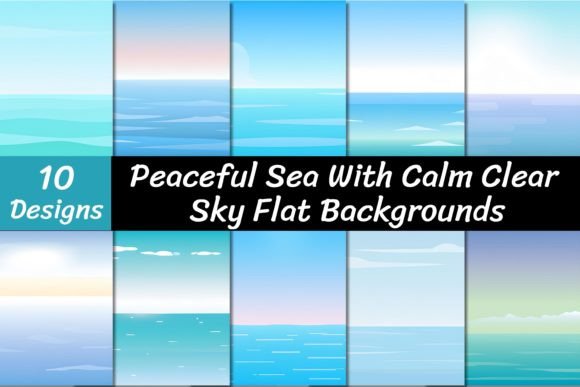
When you look at the Peaceful Sea with Sky Flat Backgrounds collection, the first thing that strikes you isn't complexity—it's restraint. These are flat design illustrations featuring undulating ocean waves beneath a clear, open sky, rendered in a cartoon style that strips away unnecessary detail. The palette leans toward soft blues, teals, and gentle gradients that suggest early morning light or the quiet hour before sunset. There's no photographic realism here, no crashing surf or dramatic clouds. Instead, you get a controlled, predictable visual environment that communicates stability, openness, and ease.
That simplicity is the entire point. Flat backgrounds like these exist to support other design elements without competing with them. Think of them as the visual equivalent of a deep breath—they create space. The cartoon aesthetic keeps things approachable and slightly playful, which means they work across audiences that might find hyper-realistic imagery either too sterile or too busy. Each digital paper measures 3600 x 3600 pixels at 300 DPI, giving you enough resolution for both screen and print applications without worrying about pixelation or quality loss.
Where These Backgrounds Actually Work
Let's be honest about what a collection like this is and isn't. These aren't hero images for a Fortune 500 website. They're not going to anchor a gritty editorial spread or replace a professional product photo. What they do well is serve as foundational layers for projects that need a calm, consistent visual tone without the overhead of custom illustration work.
Digital and web design applications are probably the most immediate fit. Website section backgrounds, landing page hero areas behind text blocks, email newsletter headers, and presentation slides all benefit from a non-distracting backdrop that still feels intentional. The flat style renders cleanly at any screen size, and the generous pixel dimensions mean you can crop aggressively without losing quality. For social media graphics, these work particularly well behind quote cards, announcement posts, and story backgrounds where you want the content itself—not the backdrop—to carry the message.
On the print side, think about packaging inserts, thank-you cards, notebook covers, journal backgrounds, and scrapbooking elements. The 300 DPI resolution handles standard print sizes comfortably. Small business owners creating branded stationery or Etsy sellers designing printable wall art will find the collection practical for producing polished results without commissioning custom artwork. The cartoon style also makes these backgrounds suitable for children's activity pages, educational materials, and lighthearted marketing collateral where a photographic approach would feel mismatched.
How Background Choice Shapes Audience Perception
Backgrounds do more than fill empty space—they set emotional expectations before a single word gets read. A noisy, textured backdrop signals energy and urgency. A dark, moody gradient suggests sophistication or drama. Peaceful Sea with Sky Flat Backgrounds communicates something specific: trustworthiness, calm, and clarity. For brands in wellness, travel, mindfulness, lifestyle coaching, or coastal-themed retail, this visual language aligns naturally with their positioning. The consistency across all ten papers in the collection also supports brand identity work, where maintaining a cohesive look across touchpoints matters more than any single design's impact.
From a visual hierarchy standpoint, flat backgrounds earn their keep by receding. When the backdrop doesn't fight for attention, typography, logos, and calls to action move forward in the viewer's perception. This is where pairing decisions become important. A clean sans serif font over these backgrounds will reinforce the modern, uncluttered feeling. A handwritten or script font introduces warmth and personality without the background feeling chaotic. Even a bold display font can work if you're using the background behind a minimal layout—think a single headline and a logo, nothing more.
Practical Guidance for Working With This Collection
Before downloading, assess whether the visual style genuinely fits your project's tone. A flat, cartoon ocean is perfect for a beach vacation blog or a meditation app's promotional graphics. It's less convincing as a background for a law firm's annual report. Matching the personality of your design assets to the personality of your brand or message is the single most important evaluation step, and it's one that saves more time than any technical specification check.
Once you've downloaded and unzipped the files—you'll need WinZip, WinRAR, or your operating system's built-in extraction tool—spend time reviewing all ten variations. They likely differ in color temperature, wave density, sky proportion, and tonal value. Some will work better for light-themed designs, others for layouts that need more visual weight in the lower half. Don't default to the first one you open.
Test your typography choices directly on the backgrounds before committing. Place your headline, body text, and any UI elements on the canvas and evaluate readability at actual viewing size. Light text on a light blue sky might look elegant in concept but fail accessibility contrast checks in practice. Darker text tones or adding a subtle semi-transparent overlay behind text blocks can solve this without undermining the background's visual character.
For commercial projects, verify the licensing terms that come with the collection. Most premium design asset packages include commercial use rights, but specifics vary—some restrict resale of the raw files, others allow unlimited commercial use in end products. Understanding these boundaries upfront prevents problems later, especially if you're creating client work or products for sale.
Getting Real Value From Flat Design Assets
The designers, marketers, and content creators who get the most from collections like Peaceful Sea with Sky Flat Backgrounds are the ones who treat them as starting points, not finished products. Layer your own color adjustments. Combine them with other design elements. Use them as mood-setting layers behind more complex compositions. The ten included variations give you enough range to maintain visual interest across a multi-page document or a series of social posts without everything looking identical.
Flat design assets reward thoughtful composition. Because there's no photographic texture or intricate detail to lean on, your layout decisions—spacing, alignment, type size, color contrast—become more visible and more consequential. That's actually an advantage. It forces clarity, and clarity is what makes designs communicate effectively across different screens, print sizes, and viewing contexts.
If your current project needs a background that steps back, supports your content, and quietly reinforces a feeling of ease and openness, this collection deserves a closer look. Download it, extract the files, and spend an afternoon testing it against real work. You'll know quickly whether the visual language fits—and when it does, you'll have ten reliable options ready for everything from web mockups to printed materials.